Skip to content
Games

Puppets

Summary

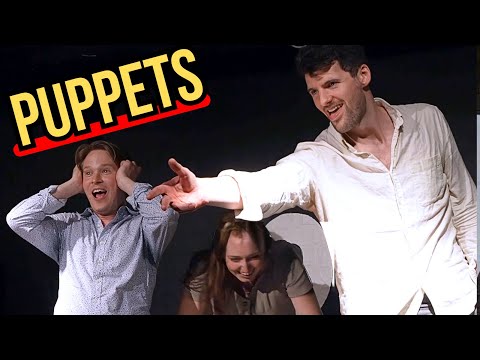
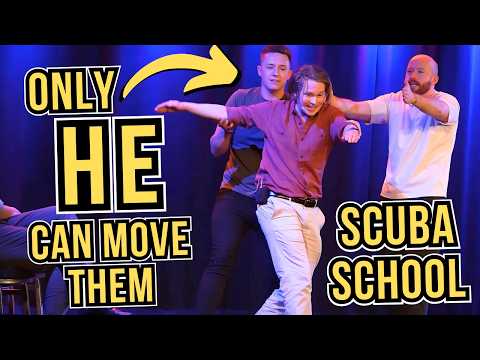
Puppets is an improv format in which two players act out a scene while their entire motor activity (arms, legs, head) is controlled by two puppeteers — usually volunteers from the audience. The actors are only allowed to move their eyes and mouths on their own; every externally driven gesture has to be folded organically into the role ("movement first, meaning later"). Movement impulses are given directly on the body — a gentle press in the back of the knee, for example, triggers a step — and any jerky motion is off-limits. The format forces radical slowdown and extreme attentiveness; the comedy comes from the contrast between deep acting and clumsy remote control.

In detail

Roles and setup

  • The puppets: They stay physically loose and relaxed. They give up control and wait patiently for physical impulses, instead of anticipating moves.
  • The puppeteers: They work behind or beside the actors and steer head, limbs and torso through direct contact — never grab the clothing.
  • Audience version: When spectators are used as puppeteers, the host should briefly demonstrate the principle (waving, walking, turning the head) up front, to lower inhibitions and ensure safety.

Steering technique

  • Range of motion: Puppeteers have to respect that joints — especially the neck — have natural limits.
  • Locomotion: Agree in advance how walking will work. The usual signal is an impulse against the back of the knee or a gentle push against the lower back, after which the puppet takes a step.
  • Interaction: When a third character enters the stage, the puppeteers can react flexibly and briefly steer the new person too.

Strategies for the actors

  • Active start: Don't begin stiff like soldiers; pick a dynamic pose — sitting or leaning, for example. That gives the scene direction immediately.
  • The art of justification: Every externally driven movement gets folded organically into the role or dialogue.
    • Make sense of it: Why am I pointing at the ceiling right now? Maybe there's a crack up there, or a UFO.
    • Don't comment on everything: Not every twitch needs an explaining word; often an emotional facial expression or a meaningful look at the partner is enough.
  • Provoke impulses: Use the text to provoke movement ("Look at me when I'm talking to you!"), which the puppeteer then carries out.

Pedagogical learning goals

  • Group listening: Pay attention to the verbal partner and the physical impulses from the puppeteer at the same time.
  • Mistake management: Unwanted or "wrong" moves from the audience aren't mistakes — they're offers that drive the story forward.
  • Focus management: The audience's attention usually follows movement. The players use this to weight the storytelling.

Pro tips and variations

  • Safety first: Because there's physical contact, the puppeteers should be chosen carefully. Jerky shoves are absolutely off-limits.
  • Solo-puppeteer variant: To avoid chaos, a single puppeteer — often an experienced improviser — can steer all characters on stage. That gives a cleaner picture and more focused storytelling.
  • Keep the connection: Despite the physical absurdity, the emotional relationship between the characters should stay at the centre. The more honestly the scene is played, the stronger the comedy.

Videos

Puppets – Pineapple Improv
Click loads data from YouTube

Puppets – Pineapple Improv

Puppets: Divorce Drama – Shoot From The Hip
Click loads data from YouTube

Puppets: Divorce Drama – Shoot From The Hip

Puppets: Axe Throwing – Shoot From The Hip
Click loads data from YouTube

Puppets: Axe Throwing – Shoot From The Hip

Puppets: Weird Scuba – Shoot From The Hip
Click loads data from YouTube

Puppets: Weird Scuba – Shoot From The Hip

Puppets (Live From Times Square) – Pineapple Improv
Click loads data from YouTube

Puppets (Live From Times Square) – Pineapple Improv

Last edited by improwiki, 29.04.2026 15:16 · Version History · ·

More from this category

Follow group

When this group creates new events, they'll automatically appear in your personal event list. You need to be logged in for this.

Log in now